.avif)
The Americans with Disabilities Act applies to your website the same way it applies to your physical storefront. If your responsive site isn't accessible web design compliant, you're exposing your business to lawsuits that averaged $25,000 in settlement costs in 2024.
How Did Website Accessibility Become a Legal Requirement?
Before 2010, businesses treated web accessibility as optional. The ADA, passed in 1990, didn't mention websites because the commercial internet barely existed.
Target Corporation's $6 million settlement in 2008 changed everything. A blind customer sued because their site didn't work with screen readers. Courts started interpreting Title III of the ADA to include websites as "places of public accommodation."
The Department of Justice tried creating specific technical standards but abandoned those efforts in 2017. Courts began defaulting to WCAG (Web Content Accessibility Guidelines) as the legal benchmark—even though WCAG is a voluntary international standard, not U.S. law. This created a confusing landscape where businesses face legal liability without explicit federal regulations.
What Makes Responsive Design Legally Risky for Accessibility?
Responsive design adapts layouts across devices using flexible grids and media queries. That execution often creates compliance gaps in accessibility in web development.
Touch targets that shrink on mobile viewports create the biggest legal risk. WCAG 2.1 Level AA requires interactive elements to be at least 44×44 pixels. When your desktop button scales down to 28 pixels on a phone, you've violated the standard—and created grounds for a lawsuit.
Navigation hamburger menus present another vulnerability. Many implementations fail with keyboard navigation or don't announce themselves properly to screen readers. A user who can't tab through your menu encounters what courts call a "barrier to access."
Forms create the third major exposure point. When error messages appear only as red text, users with color blindness miss them entirely. When placeholder text disappears on focus, users with cognitive disabilities lose critical context.
Understanding Your Legal Obligations Under ADA
Federal courts have consistently referenced WCAG 2.1 Level AA as the accessibility standard in judgments. This creates a de facto legal requirement for ADA compliant web design.
Your obligations vary by business type:
- Private companies with physical locations: Title III applies to retail, restaurants, hotels, healthcare facilities, and entertainment venues. No revenue threshold exists—a single-location bakery faces the same obligation as a national chain.
- State and local government entities: Title II creates stricter requirements. Government websites must comply with Section 508 standards, which closely mirror WCAG 2.0 Level AA.
- Federal contractors: Contracts exceeding $10,000 trigger Section 508 compliance as contractual law.
- Private online-only businesses: This remains legally ambiguous. The Supreme Court declined to resolve this in Domino's Pizza v. Robles (2019).
The safer assumption: if you conduct business with the public, your site needs to meet web design accessibility standards.
{{vad-quote-1}}
What Are the Real Consequences of Non-Compliance?
ADA website lawsuits increased 14% in 2024, with 4,605 federal cases filed. New York's Southern District alone saw 1,832 filings.
Financial exposure breaks down into three categories:
- Settlement costs: Most cases settle for $20,000–$35,000 plus plaintiff attorney fees of $10,000–$15,000. Total cost: $30,000–$50,000 per lawsuit.
- Remediation expenses: Fixing accessibility issues post-lawsuit costs three times more than building them in from the start. Budget $40,000–$120,000 for comprehensive remediation on a mid-sized e-commerce site.
- Ongoing monitoring: Court settlements typically require annual accessibility audits for three years. Add $8,000–$15,000 annually.
Serial plaintiffs make this worse. Law firms identify businesses with accessibility violations, then file dozens of lawsuits simultaneously. Five separate plaintiffs sued the same retail chain in March 2025. The company faced $150,000 in combined legal exposure.
Understanding the legal exposure from ADA violations is critical, but equally important is recognizing the opportunity cost of delayed compliance. Every day your site remains inaccessible, you're not just risking lawsuits—you're actively losing revenue from users who can't complete transactions.
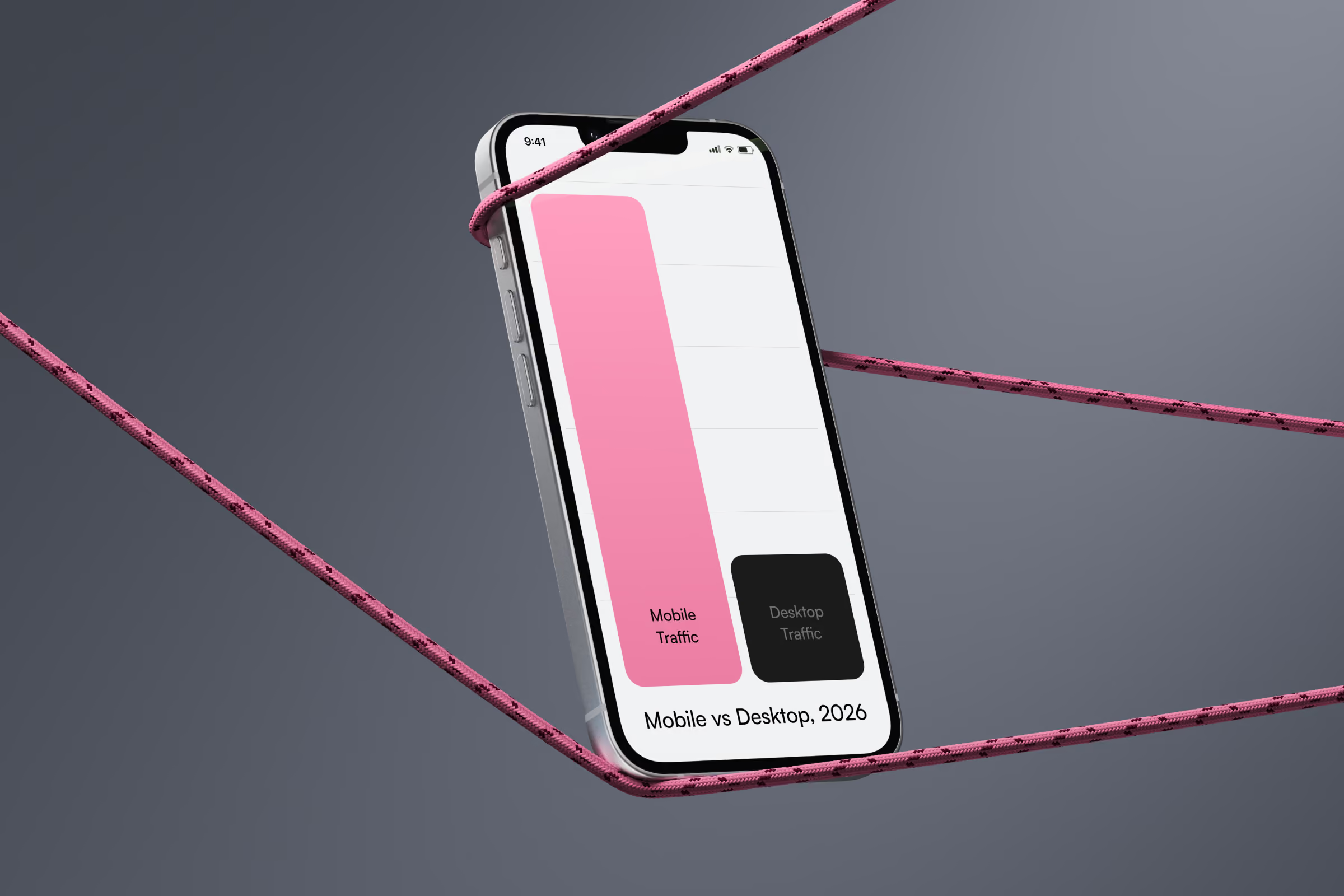
Mobile traffic now accounts for over 60% of e-commerce visits, and accessibility barriers on mobile viewports compound the problem. The ROI of responsive web design in mobile-first environments demonstrates that businesses achieving WCAG Level AA compliance see average conversion rate optimization improvements of 12–18% across mobile devices, largely because accessible design principles overlap directly with mobile usability best practices. When touch targets meet the 44×44 pixel requirement, all users benefit—not just those with motor disabilities.
Where Do Teams Unknowingly Create Legal Exposure?
Even compliance-conscious teams create violations through three common practices in accessibility in website design:
Using color as the only method to convey information: You run a contrast checker and everything passes. Red for errors, green for success. Clean. Minimalist.
But users with deuteranopia (red-green colorblindness affecting 6% of men) can't distinguish your error states from success states. A user attempts to submit your checkout form five times, can't understand why it keeps failing, and abandons a $300 cart.
You're bleeding revenue while sitting on a WCAG 1.4.1 violation. The fix: add icons, text labels, or patterns alongside color to improve usability.
Hiding skip navigation links on mobile: Your desktop site has a keyboard-accessible skip link. But your mobile CSS hides it with display:none because it "clutters the minimal interface."
Keyboard users on mobile—Bluetooth keyboard users, switch device users—must tab through 47 navigation items to reach your main content on every page. A task that should take 2 seconds takes 90 seconds. You've violated WCAG 2.4.1 and damaged the overall user experience. The lawsuit includes screenshots showing the skip link's absence on mobile.
Treating ARIA labels as complete accessibility: You added aria-label="Search" to your search icon button. No visible text, just the icon and ARIA.
ARIA only helps screen reader users—about 2% of your traffic. Users with cognitive disabilities need visible text labels to understand icon meanings. Users with low vision who zoom to 400% see an unlabeled icon. WCAG 2.5.3 requires labels visible to all users, not just announced to assistive tech—a core principle of inclusive web design.
WCAG Levels Explained: What Your Business Actually Needs
WCAG organizes requirements into three conformance levels: A, AA, and AAA. Understanding these levels is essential for ADA compliance web design.
Level A covers minimum accessibility—missing alt text, keyboard traps, auto-playing audio. If you don't meet Level A, your site is unusable for people with disabilities.
Level AA is the legal standard. Federal courts reference Level AA in 94% of accessibility rulings. This includes 4.5:1 contrast ratio requirements for normal text, proper heading hierarchy, and form labels programmatically associated with inputs.
Level AAA requires 7:1 contrast ratios, captions for all audio content, and sign language interpretation for videos. Courts have never required AAA compliance. The effort-to-benefit ratio makes it impractical for most businesses.
For legal protection, Level AA is your target—this represents the baseline for ADA compliant website examples.
Can Accessibility Overlay Widgets Actually Protect You?
Accessibility overlay widgets promise one-line compliance: drop in a script, and users can adjust colors, text size, and contrast themselves.
The National Federation of the Blind and 400+ disability advocates signed an open letter in 2021 calling overlays "actively harmful." Their argument: overlays mask underlying code problems without fixing them.
Courts are starting to agree. A New York judge ruled in Murphy v. Eyebobs (2022) that installing an overlay widget didn't constitute good faith remediation because the underlying site remained inaccessible.
Here's the fundamental issue: overlays run client-side JavaScript over broken HTML. If your heading hierarchy is semantically wrong (div class="heading" instead of h2), an overlay can't fix that. Screen readers still encounter gibberish.
Overlays solve one specific problem: they let users with mild visual impairments adjust display settings. That's useful for maybe 15% of accessibility needs. For the other 85%—keyboard navigation, screen reader compatibility, semantic HTML structure—overlays do nothing.
The risk-adjusted recommendation: don't treat overlays as compliance solutions. If you deploy one, do it in addition to proper WCAG implementation, not instead of it—this applies whether you're working with an ADA compliant website designer or in-house team.
{{mike-quote-1}}
How Does Responsive Web Design Accessibility Testing Differ?
Desktop testing catches maybe 60% of accessibility issues. Mobile viewports introduce unique violations that desktop audits miss entirely.
Touch target sizing creates the most common mobile-specific failure. A navigation link that's 48×48 pixels on a desktop might collapse to 32×40 pixels at 375px viewport width. WCAG 2.5.5 requires 44×44 pixels minimum.
Focus states disappear differently across viewports. Your desktop site shows a 2px blue outline on focused elements. But your mobile CSS removes outlines to "clean up the interface." Keyboard users can't track focus position. That violates WCAG 2.4.7.
Test across at least four breakpoints: 320px (small mobile), 768px (tablet portrait), 1024px (tablet landscape), and 1440px (desktop). Run keyboard navigation tests at each. Verify touch target sizes with browser dev tools at each—essential practice for accessible website development.
The urgency around mobile accessibility compliance becomes clearer when you examine the actual user behavior data. Mobile traffic share now exceeds 63% across most industries, but mobile conversion rates historically lag desktop by 40–50%. The gap narrows dramatically on accessible sites—those meeting WCAG Level AA see mobile-first design performance that's statistically indistinguishable from desktop.
The responsive web design statistics and mobile conversion rates reveal why: when touch targets meet the 44×44 pixel threshold and forms work properly with screen readers, you've simultaneously fixed the accessibility barrier and the usability friction that kills mobile conversions. The compliance investment and the conversion rate optimization investment are the same dollars.
The Essential Checklist for Accessible Website Design
Before launching any responsive site, verify these requirements for proper accessibility in UI design:
- Semantic HTML structure: Headings follow logical hierarchy (H1 → H2 → H3). Buttons are button elements, not div with click handlers.
- Keyboard navigation: Every interactive element receives focus in logical order. Focus indicators are visible at minimum 3:1 contrast. No keyboard traps exist.
- Touch target sizing: All tappable elements measure at least 44×44 pixels at every breakpoint.
- Color contrast: Text meets 4.5:1 contrast for normal text, 3:1 for large text (18pt or 14pt bold).
- Form accessibility: Every input has a programmatically associated <label>. Error messages appear as text, not just color changes.
- Responsive images: All images include meaningful alt text. Decorative images use alt="" to hide from screen readers.
- Skip navigation: A "skip to main content" link appears as the first focusable element on every page, visible on keyboard focus at all breakpoints.
These fundamentals ensure readability and digital inclusivity across all devices and assistive technologies. Looking at examples of accessible websites like the BBC homepage or the UK Government's GOV.UK demonstrates how these principles work in practice—each serves as an example of ADA compliant website implementation.
What This Means for Designing for Web Accessibility
ADA website compliance isn't a one-time checkbox. It's an ongoing development practice that requires attention to website design for disabled users.
The DOJ published proposed WCAG 2.1 Level AA rulemaking in 2023, currently in public comment. When finalized (likely 2026), it will create explicit federal standards for the first time—providing clear guidance on web accessibility and the ADA. That rulemaking will eliminate the current legal ambiguity—but also eliminate any "we didn't know" defense.
Build accessibility for web design into your development workflow now. Make it a requirement in your definition of done, not a post-launch audit. Focus on creating an accessible user interface that serves all users equally. That's not just legal protection. It's a 26% larger addressable market—the percentage of U.S. adults with disabilities according to the CDC's Disability and Health Data System.